
AU Special Envoy Calls for Decisive Action to Turn Great Lakes Peace Commitments into Lasting Stability
AU Special Envoy Calls for Decisive Action to Turn Great Lakes Peace Commitments into Lasting Stability
The African Union Special Envoy for the Great Lakes Region, Amb. Liberata Mulamula, has called on governments and regional institutions to shift from negotiating peace agreements to delivering measurable results, saying the future of peace, security and shared prosperity in the Great Lakes Region depends on effective implementation of existing commitments.
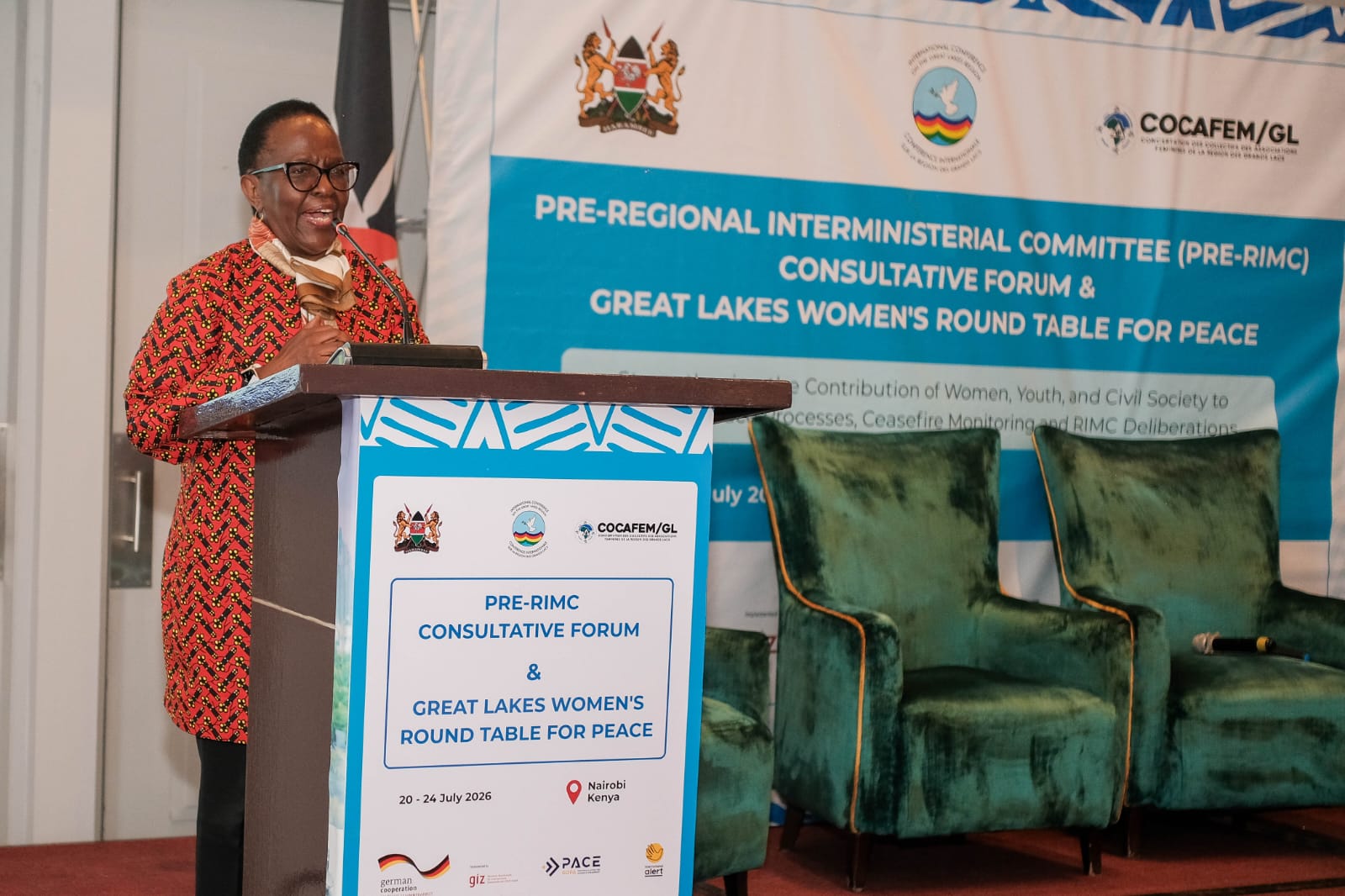
Addressing delegates at the close of the three-day PRE-Regional Inter-Ministerial Committee (PRE-RMIC) Consultative Forum and Great Lakes Women’s Roundtable for Peace in Nairobi, Amb. Mulamula said the region possesses a comprehensive framework of peace and cooperation instruments. The priority now, she noted, is ensuring these mechanisms produce tangible improvements in the lives of communities.
“The challenge is no longer the absence of agreements,” she said. “The challenge is ensuring that the agreements already in place are effectively monitored and implemented through existing regional mechanisms.”
Her remarks reinforced the forum’s central message that translating regional commitments into concrete action is critical to reducing conflict, strengthening regional cooperation, expanding cross-border trade and accelerating sustainable development across the Great Lakes Region.
Amb. Mulamula underscored that sustainable peace requires a whole-of-society approach, calling for women, young people, parliamentarians, civil society, traditional leaders and the private sector to be fully integrated into peacebuilding and governance processes.
“We cannot achieve sustainable peace, stability and development for our region and the continent while excluding important stakeholders,” she said.
She observed that the region’s growing economic and security interdependence means instability in one country can quickly affect neighbouring states, making collective action and regional solidarity indispensable. This, she noted, remains the guiding vision of the International Conference on the Great Lakes Region (ICGLR) in addressing shared challenges through coordinated responses.
Reaffirming the African Union’s commitment to regional peace and stability, Amb. Mulamula said the Office of the AU Special Envoy would continue working with governments and regional partners to elevate the voices of women, youth and local communities, recognising their indispensable role in conflict prevention, mediation and long-term peacebuilding.
She also highlighted the forum’s emphasis on intergenerational dialogue, describing the engagement between experienced leaders and emerging young peacebuilders as a strategic investment in strengthening the region’s future leadership and resilience.
Calling for a renewed implementation agenda, the AU envoy urged governments to reinforce existing peace mechanisms with sustained political commitment, predictable financing and stronger accountability frameworks rather than creating new agreements that remain unimplemented.
Amb. Mulamula acknowledged the Government of Germany and GIZ for their longstanding support to regional peacebuilding and institutional development, noting that such partnerships continue to strengthen the capacity of regional organisations to respond to evolving security and governance challenges.
Recognising the pivotal role of legislatures, she encouraged parliamentarians to champion the ratification and implementation of the African Union Convention on Ending Violence Against Women and Girls, describing it as a critical instrument for advancing women’s rights, protection and participation in peace processes.
She announced that recommendations from the Nairobi forum would inform deliberations at the forthcoming Pan-African Parliament session in Midrand, South Africa, while also contributing to discussions within the Forum of Parliaments of the ICGLR. The recommendations emphasise stronger collaboration between governments, legislatures, civil society, women’s organisations, youth movements and the private sector in advancing regional peace and development.
The forum also marked the 25th anniversary of the Concertation des Collectifs des Associations Féminines de la Région des Grands Lacs (COCAFEM), celebrating its evolution from a network of women’s organisations in three countries into a regional movement spanning twelve Great Lakes states. Amb. Mulamula described the milestone as evidence of the growing influence of women-led organisations in conflict prevention, mediation and peacebuilding across the region.
She further commended the participation of the Joint Intelligence Fusion Centre, military leadership and regional security institutions, noting that closer collaboration between security actors and civilian stakeholders remains essential to addressing persistent insecurity, particularly in eastern Democratic Republic of the Congo.
As the Nairobi consultations concluded, Amb. Mulamula called on participants to maintain the momentum generated through sustained dialogue, stronger partnerships and collective action. She invited delegates to continue advancing the region’s peace agenda at the upcoming Great Lakes Youth and Women’s Forum in Bujumbura, Burundi.
The Nairobi forum concluded with a clear diplomatic message: the credibility of regional peace architecture will ultimately be judged not by the number of agreements adopted, but by the collective commitment to implement them, strengthen regional cooperation and deliver lasting peace, security and prosperity for the people of the Great Lakes Region.